
Looking for a step-by-step guide on proposal submissions or more information on the award life cycle? This section provides in-depth guidance on contract and grant management, grant funding, and financial accounts.
The major steps involved in submitting a proposal are:
- Reading RFP/agency guidelines
- Developing a scope of work
- Identifying key personnel
- Determining necessary resources
- Preparing budget and budget justification
- Completing agency and internal forms
- Obtaining necessary approvals
- Reviewing and submitting proposal
“Where do I start?”
Step 1. Contact your fund manager at least 3 weeks prior to the deadline to inform them of the upcoming proposal. Provide your fund manager with the following basics:
- Program announcement/agency guidelines.
- Agency Due Date
- Fund limitation
- Project duration and dates
- Preliminary budget (can be sent on a word document)
- Consortium information (if applicable) and consortium Fund Manager
Step 2. Your fund manager will prepare a specialized budget using an internal budget template. A draft of the budget will be forwarded within 1 week of being informed. Upon PI review and approval of the budget, your fund manager will begin to work on the following internal documents:
- Epass – an internal campus form used for review and approval of proposals to extramural funding agencies. Your fund manager will provide you with this form for your signature.
- 740 Form – Statement of Financial Interest Related to Sponsored Projects, for federal or state programs.
- 700-U – Statement of Economic Interest for Non-governmental Entity
- eDGE Disclosure – financial disclosure submitted annually for PHS grants. Disclosures are submitted through the Conflict of Interest site”
* Note: All internal documents will be forwarded to PI’s respective mailboxes within 1-2 days of completion. Please return to fund manager once all forms are signed.
Step 3. It is the PI’s responsibility to provide fund managers with all the required scientific/technical documents for the submission. Proposals and all internal documents are due to OCGA for review 5 working days before they need to be submitted electronically or mailed. Therefore, proposals and documents are due to fund managers no later than 7 business days before the sponsor deadline.
Step 4. Your fund manager will upload all documents to the UCLA Grants System no later than 7 business days before the sponsor deadline.
Step 5. A final PDF version of the proposal will be emailed to the PI. The PI must approve the final version before it is submitted by OCGA.
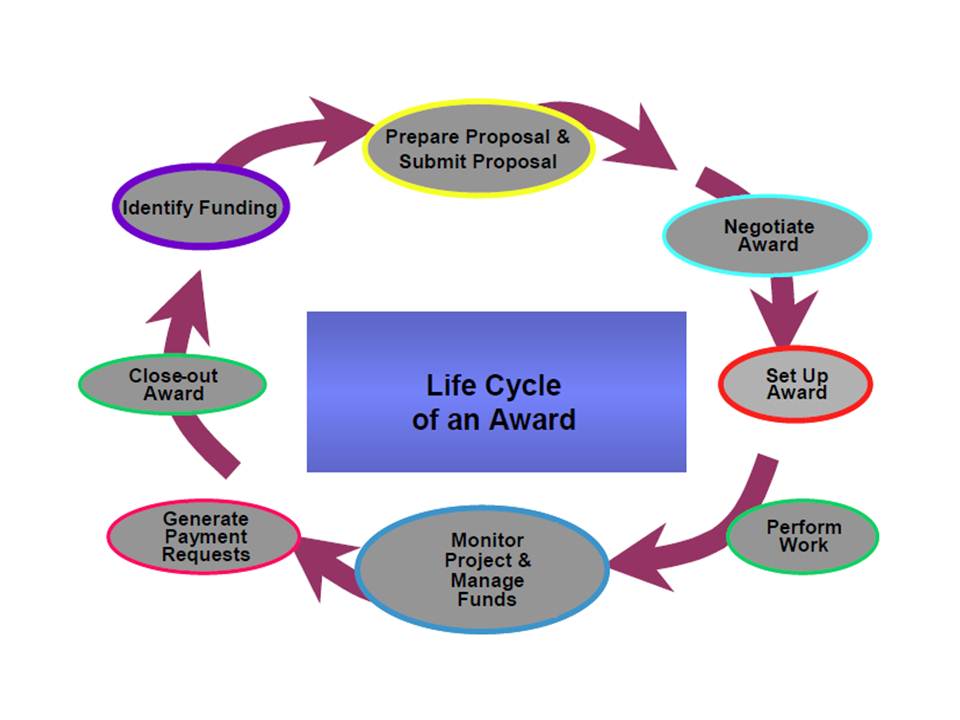
Award Life Cycle
It is critical for each individual in the life cycle to understand his/her role for the process to work. All the parts of the award life cycle are interrelated.
Where do you fit in the award life cycle?
Award Set-Up (EFM/OCGA)
Once accepted, the award must be processed and a fund number assigned. The process includes:
- Enter and update basic award data in InfoEd
- Record terms and conditions
- Determine fund number
- Communicate information (via PAN and award synopsis)
The most critical step in setting up an award is the establishment of a fund number and linkage to an account. Spending on an award cannot begin until this has been accomplished. When established, the full accounting unit (FAU) will have these components:
Account and Fund number structure
| LOC | Account | Cost Center | Fund |
|---|---|---|---|
| 1 digit | 6 digits | 2 digits | 5 digits |
| 4 | 444040 | BO | 54321 |
Request for Authorization to Spend (E-RAS)
A RAS is a request made by the PI to obtain an account/fund number for an extramurally funded project prior to receipt of actual award from the sponsor. If the sponsor allows the university to incur pre-award costs, and when the following conditions are met, OCGA can authorize pre-award spending. OCGA confirmation of the conditions below is recorded on the E-RAS form:
- There is a confirmed, pending commitment by the funding agency
- There is an essential need to advance or commit the funds prior to receipt of the award
- Other funding is available to cover the expense if there is an unanticipated delay in the start date or the agency fails to make the anticipated award
Note: Please speak to your fund manager to request an E-RAS. Such requests must be approved by the Business Office Manager and CAO.
Perform Work (PI/Department)
In order for the project to begin, the PI must perform the work as proposed. This involves the following necessary activities:
- Hiring project personnel
- Purchase of equipment and supplies
- Initiating orders for subawards and consultants (if applicable)
- Incurring expenditures
Items requiring prior approval may include:
- Rebudgeting
- Carry Forwards
- No-cost extensions
- Supplements
- New subawards
Transfer of Costs or Expenses
- A process to move or transfer payroll and non-payroll expenses to different funding sources.
- Costs are transferred to correct salary distribution estimates, correct clerical or bookkeeping errors, transfer pre-award costs
- Cost transfers should be the exception, not the norm
- Transfers should be done on a timely basis
Financial Management (PI, Dept., EFM)
Projects must be monitored and financially managed through all stages of development by:
- Checking budget and terms and conditions
- Reallocating funds to appropriate subs
- Reviewing ledgers
- Preparing reports based on ledgers
Roles and Responsibilities
- Many individuals can be involved in the life cycle of an award. Team players include:
- UCLA Central Administrative Offices
- OPRS (Office for the Protection of Research Subjects)
- EHS (Environment Health and Safety)
- Equipment Management
- Gift Services
- Graduate Division
- Audit and Advisory Services
- Purchasing and Accounts Payable
- OIP (Office of Intellectual Property & Industry Sponsored Research)
- Risk Management
- UC Office of the President
- Department Administration
- PI – a faculty member or research who is authorized under UCLA policy 900 to serve as the scientific leader or director of a project. Duties of the PI include defining and completing the scope of work, assuring scientific and financial integrity, preparing technical and scientific reports, and adhering to University policies as well as to award terms and conditions.
- Fund Manager – the administrative support team who assists the PI with fiscal and administrative management of the award including purchasing, report preparation, rebudgeting, travel, no cost extensions, proposal preparation, award close out.
- Dept. Administrator
- Chair
- Dean
- Sponsor
Closeout of Award (all parties)
Projects are considered completed or “closed out” after the sponsor receives and approves all reports as required by the terms and conditions of the award. Most common close-out reports are:
- Technical (PI is responsible)
- Financial (EFM is responsible)
- Patent/Invention (OIPA and/or PI responsible)
In an effort to remain compliant with the Office of Payment Solutions & Compliance and UC BUS-49, Policy for Cash Handling and Cash Equivalents, below are a few friendly reminders pertaining to the use and handling of research human subject disbursement funds:
- Expenses paid from a Research Human Subject Disbursement can only be made for the purpose for which fund was authorized and must be supported by receipts. An excel spreadsheet must be supplied to the Business Office for replenishment or within 90 days of disbursement, whichever occurs first.
- When not in use, the fund currency must be placed in a safe or a locked receptacle, which is kept in a properly secured area. Storing of cash is based on the following cash limits:
- Up to $1,000 in a lockable receptacle
- From $1,001 to $2,500 in a safe
- From $2,501 to $25,000 in a steel door safe, with a door thickness of not less than 1 inch and wall thickness of not less than ½ inch.
- Before requesting payment, there must be a current IRB approval number on file with the Office of Human Research Protection Program (OHRPP). Disbursement type (cash, gift card, or Bruincard deposit) must match the current IRB approval number on file with OHRPP or the request will be denied.
- Cash will only be released to the authorized personnel(s) and PI identified on the form. Authorized personnel(s) must be active UCLA employees.
- A delivery fee of $10.12 for on-campus and $16.68 for off-campus will be assessed for each request.
- Any unused cash can be deposited and credited to your account. When bringing deposits to the Business Office, cash must be physically handed to a Fund Manager or the Financial Manager.
Please do not leave cash on desks, in-boxes, mail slots etc. Cash must be counted in dual custody – Fund Manager and PCF custodian . - In the event of a theft, the loss must be reported to the campus police immediately, at ext. 51491.
Prolific
Prolific is a platform that connects researchers to their target participant pool and is based in the UK. In order to use Prolific as a vendor the PI or research staff must first contact Prolific’s customer service at info@prolific.co to obtain an invoice for study costs that includes the required tax language for UCLA. Once you receive this invoice, please submit it as per standard practice to psych_orders@psych.ucla.edu. The Business Office will process your invoice and submit for payment. We will provide you with the purchase order number related to your request that you can use to follow up with Prolific and confirm the credit to your account. Payments to Prolific are made via wire transfer. Please note that international transfers do not settle immediately due to varying time zones and banking standards abroad. Total processing time from the time we receive your request to the time that a wire transfer settles is about 7-10 business days. Once the wire transfer settles your Prolific account is funded with the amount specified on your request. Please account for this timing when planning your studies.
Wire Transfer Minimums
The University wire transfer minimum is $200. If your request is for less than $200 we will group it together with other departmental wire requests to the same vendor. This may delay the processing time since processing will depend on whether we have other requests to use for this grouping.
Mturk and CloudResearch
Amazon Mechanical Turk (MTurk) and CloudResearch provide platforms aimed at recruiting study participants and are both based in the U.S. Researchers interested in MTurk or CloudResearch, would need to complete the request form and provide login credentials to the account that will be funded. The request form should be emailed directly to the PI’s assigned fund managers and must be either signed by the PI of the fund being charged or have the PI copied on the email request, per our standard departmental ordering procedures.
Mturk and CloudResearch accounts are funded using departmental pre-loaded credit cards. The fund manager will confirm once the transaction is completed. Requests typically take 3-5 business days to fully settle from the time that the request is received. Please account for this in planning your studies. Please use the Amazon Mturk and CloudResearch Request Form for this type of request.
Google Cloud
More information coming soon….
Purchasing Gift Cards
Gift cards can be purchased for the purpose of distributing to employees and human subjects, all of which have a distinct procedure. A gift card order will be assessed a delivery fee of $10.05 for on-campus and $15.55 for off-campus.
- To purchase gift cards for employees please submit an Employee Recognition Program Form to your assigned Fund Manager.
- To purchase gift cards for Human Subjects, please complete the Research Human Subject Disbursement Request Form.
Preferred gift cards include:
Amazon, Kroger, Starbucks, and Target. Denominations vary based upon the vendor: Gift Card Types. There are no processing or shipping fees if gift cards are ordered from the preferred vendor list. Any unused gift cards can be returned to the Business Office and a credit will be posted to your account.
Non-Preferred Gift Cards include:
Shell, Mobil, Chevron, and Ralphs. These vendors charge varying shipping and processing fees per order and may take up to 4 weeks for processing. Unused non-preferred gift cards may not be returned for a credit.
Note: Gift cards are considered the same as cash and required the same level of security. A designated custodian must be identified and the cards secured in keeping with UC Business and Finance Bulleting BUS-49. To further explain, BUS-49 Policy IX.5 states that each campus shall use lockable receptacles or burglarproof/fire resistant safes to store cash based on the following cash limits.
Related Links
- UCLA’s Office of Contract and Grant Administration (OCGA)
- UCLA Office of Research Adminitration (ORA)
- Office of the Human Research Protection Program (OHRPP)
- Office Intellectual Property (OIPA)
- Office of Extramural Fund Management (EFM)
- National Institute of Health (NIH)
- National Science Foundation (NSF)