
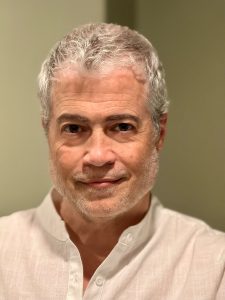
We navigate our lives with the unshakable conviction that we see the world exactly as it is—an “open window” to reality. Yet, this feeling is a powerful illusion; we are actually viewing the world through idiosyncratic lenses that combine with input from the world to construct our reality while hiding the construction process from us. This misunderstanding is the hidden root of social conflict and our deepening crisis of loneliness.
In the UCLA Social Cognitive Neuroscience (SCN) Lab, Dr. Matthew Lieberman investigates this phenomenon, which he terms CEEing (Coherent Effortless Experience). When we experience any event, like two people talking, we feel we are simply “seeing” what is there. We “see” one person being hostile and the other being defensive. We see this as easily as seeing that a rose is red. And yet color does not exist in the world – our brain adds this to what we see. Similarly, our brain adds socioemotional meaning (e.g., hostile, defensive). Just as with color, we don’t realize these meanings are being added by us to what we see.
To understand how our constructed realities collide in the wild, the SCN Lab uses functional near-infrared spectroscopy (fNIRS) to capture neural data outside the traditional scanner environment. This portable technology allows members of the SCN Lab to study the neural responses of strangers becoming friends, of ideologically opposed individuals arguing, of actors getting lost in a character they are portraying, and of teams working together in real-world contexts ranging from music production studios to firemen doing emergency medicine training to CEOs sitting around a table talking shop.
Dr. Lieberman’s work reveals that we are “meaning-making machines” that use our idiosyncratic psychological lenses to make sense of all the ambiguous information coming from the world. While this allows us to navigate the world efficiently, it creates a “compatibility problem” in our social lives. When our lenses align with others, we experience the same reality making it easier to connect. Dr. Lieberman co-founded the company Resonance, an artificial intelligence company dedicated to addressing the growing loneliness epidemic. By identifying and matching people based on their unique lenses—how they actually “see” the world—Resonance’s algorithm helps people find others they are truly likely to connect with.
Dr. Lieberman was born in Atlantic City, NJ. After completing a double major in Philosophy and Psychology at Rutgers University, he went on to get his Ph.D. in Psychology at Harvard University, advised by Dr. Daniel Gilbert. Dr. Lieberman and his graduate student friend Dr. Kevin Ochsner are commonly credited with being two of the founders of the field of Social Neuroscience. Dr. Lieberman hosted the first ever conference on Social Neuroscience in 2001 and was the founding editor of the journal Social Cognitive and Affective Neuroscience (SCAN) from 2005 to 2025. The SCN Lab has served as a training ground for many leaders in the field including Emily Falk, Molly Crockett, Meghan Meyer, Ajay Satpute, David Creswell, David Amodio, Elliot Berkman, Jennifer Pfeifer, Shannon Burns, Baldwin Way, and Eva Telzer.
Category: Spotlight