
Why does the world look the way it does? We experience vision as direct contact with reality. The world appears to be “there,” fully formed in front of us. Yet from the perspective of the brain, perception is an extraordinarily difficult problem. The retinal image is only two-dimensional (2D), incomplete, and fundamentally ambiguous. Many different 3D worlds could produce the same image projected onto the retina. And yet, almost effortlessly, we perceive a stable and coherent reality. My research asks how the brain accomplishes this.
One way to glimpse the problem is through visual illusions. In my lab, we study a phenomenon called the stereokinetic illusion, in which a rotating 2D image suddenly appears as a coherent 3D object extending in depth. Marcel Duchamp famously explored this phenomenon in his Rotoreliefs. Although the perception is illusory, observers perceive it in remarkably systematic ways. To me, this suggests that illusions are not failures of the visual system, but windows into the assumptions the brain uses to interpret the world.
I approach these illusions much as one approaches a mathematical puzzle—not as curiosities, but as constrained problems whose solutions reveal the underlying rules of the system. The sensory input alone is almost never sufficient to uniquely determine the structure of the world. To solve this underdetermined problem, the brain relies on assumptions that are usually adaptive in the natural environment. Most of the time these assumptions allow perception to work remarkably well. Occasionally, however, they produce illusions, and those illusions provide insight into how perception works more generally.
Stereokinetic perception captures especially clearly the kinds of questions that have long interested me about perception, ambiguity, and inference. Much of my work has focused on identifying these constraints and testing them quantitatively. In stereokinetic perception, for example, I have developed multiple methods for measuring perceived 3D shape and motion in order to directly test competing theories about how the brain resolves ambiguity.
I originally studied physics as an undergraduate in China because I wanted a rigorous foundation for understanding complex systems. Around that time, my father, who was then working in Canada, told me that brain science would likely become one of the major scientific frontiers of the future. I did not yet know what form that interest would take, but the idea stayed with me.
After college, I entered the Chinese Academy of Sciences to study biophysics, focusing on honeybee vision under scientists trained at the Max Planck Institute in Germany. There I first encountered the idea that perception could be studied as a principled computational problem rather than simply as biology or behavior.
I subsequently went to Brown University for my PhD studies in cognitive science, while also completing a master’s degree in applied mathematics. By coincidence, Heinrich Bülthoff also arrived at Brown around that time as a new faculty member from the same Max Planck Institute and knew my advisors in China. His and Dan Kersten’s work on human vision and perceptual inference strongly shaped my scientific direction and ultimately drew me into the study of visual perception.
Before joining UCLA, I conducted postdoctoral research at the NEC Research Institute in Princeton, working across both the physics division with Bill Bialek and Rob de Ruyter, and the computer science division with David Jacobs. That environment reinforced my interest in approaching perception as an interdisciplinary problem spanning physics, computation, neuroscience, and cognition.
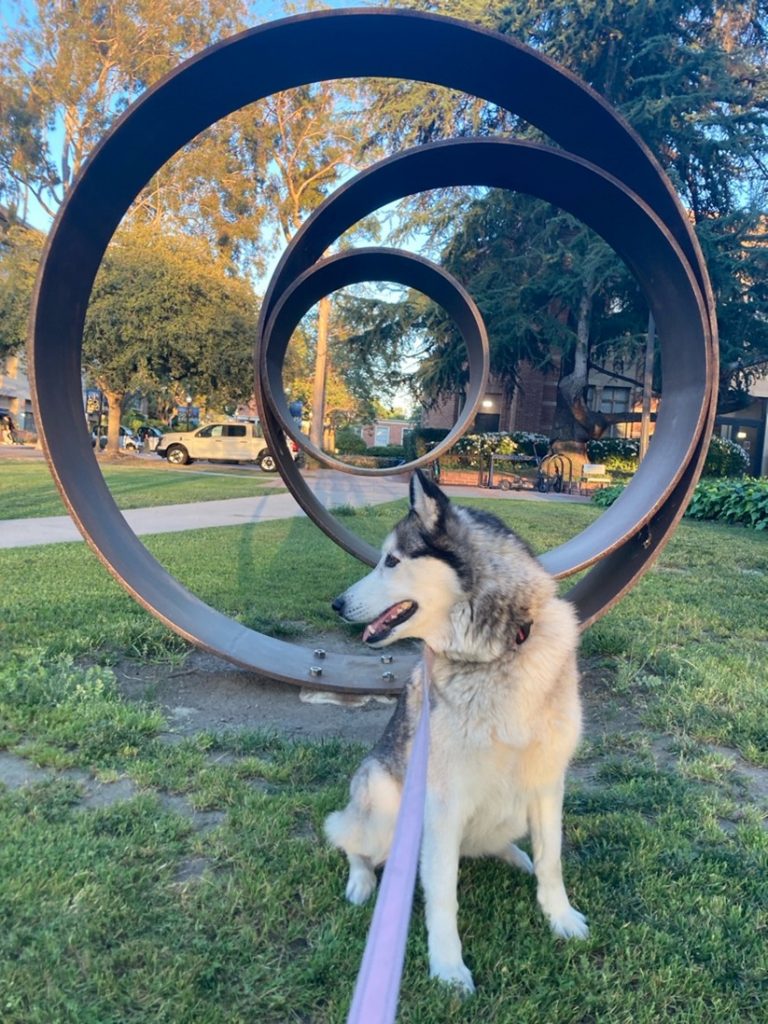
Juno in front of a sculpture on the UCLA campus whose geometry evokes the stereokinetic illusions studied in my lab.
Category: Spotlight